
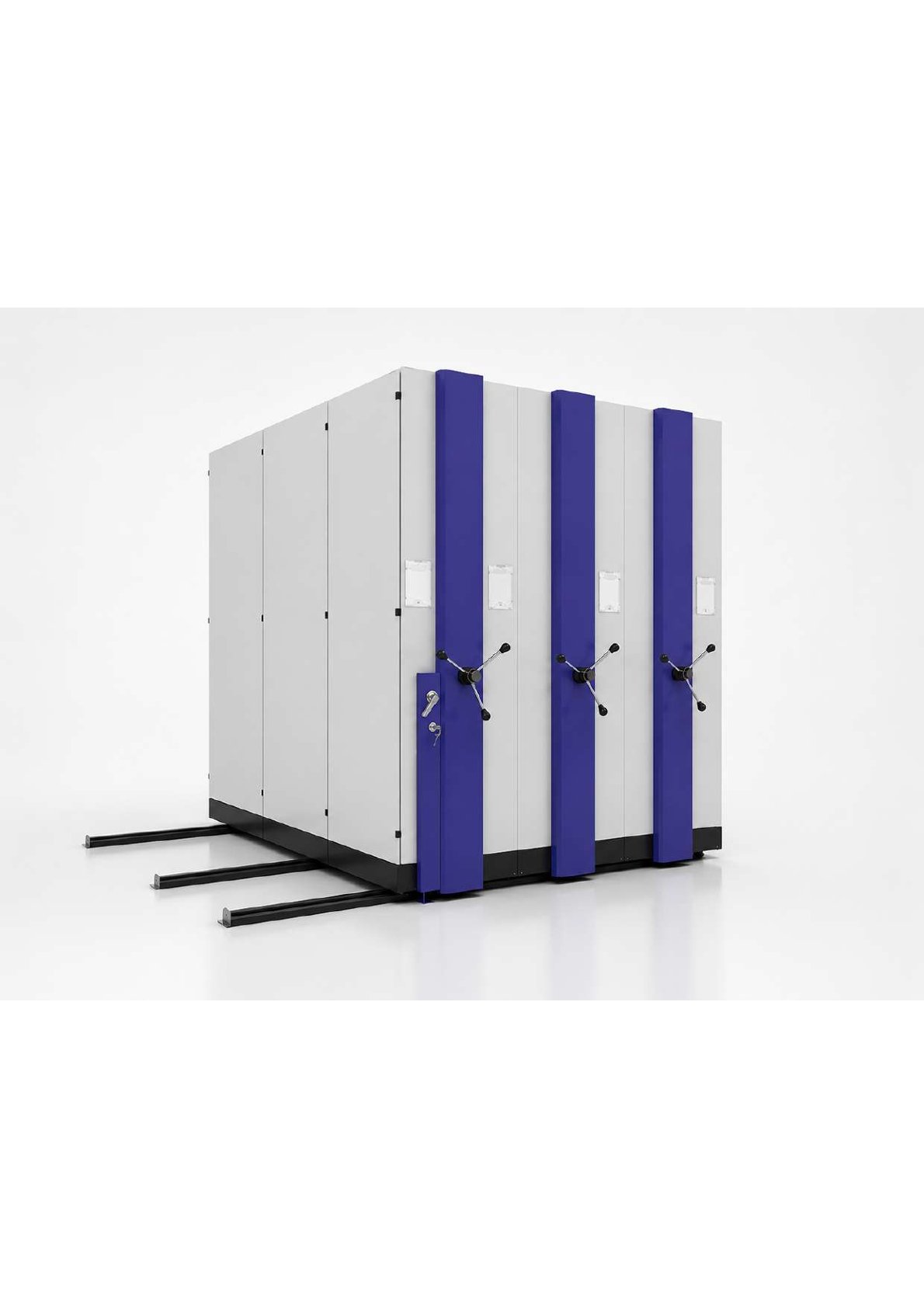
"What is the price of a mobile compactor?" is one of the most common questions we receive — and one of the hardest to answer in a single number. A mobile compactor isn't an off-the-shelf product like a chair or a filing cabinet. It's a system built to the dimensions of your room, the weight of your records and the way your team will use it.
That's why two quotes for what looks like the same room can be very different. Sometimes one supplier is overcharging. More often, the two quotes simply describe different systems — different steel gauge, different number of shelves, different track installation or a different drive mechanism.
This guide explains what actually decides mobile compactor price in India, how quotes are usually structured, how to compare them fairly, and how to calculate whether the investment pays for itself in recovered floor space.
Quick Answer: How Is Mobile Compactor Price Decided?
Mobile compactor price depends mainly on the number of bays and units, the height and depth of each unit, the number of shelves, the steel gauge, the drive mechanism (manual push or handle-operated), locking and door options, the floor track installation, the finish, and site conditions such as floor level and access. Compactors are usually quoted per bay or as a complete system after measuring the room. Because a compactor recovers roughly 40–70% of the floor space that fixed shelving would need, the real cost should be compared against the value of the space it frees up — not just against the price of ordinary steel racks.
The 9 Factors That Decide Mobile Compactor Price
1. Number of bays and units
A bay is one section of shelving between two uprights; a unit (or carriage) is one movable block of bays that runs on the tracks. More bays and more units mean more steel, more carriages and more track length. This is the single biggest driver of total cost.
2. Height of the units
File compactors are typically 6–7 feet high for comfortable reach in offices. Taller units store more per square foot but need more steel, stronger bracing and sometimes a step stool or ladder for the top shelves.
3. Depth of the shelves
Shelf depth is decided by what you store — standard files, box files, ledgers, X-ray films, archive cartons or spare parts. Deeper shelves cost more but avoid wasting space on items that hang over the edge.
4. Number of shelves per bay
More shelves per bay increase storage capacity and the amount of steel. Adjustable shelves add flexibility so the layout can change as your records change.
5. Steel gauge and load per shelf
Heavier records — ledgers, legal files, bound volumes — need thicker steel and stronger shelves. A quote using lighter gauge steel will usually look cheaper, but shelves can sag over time under dense paper loads. Always ask what gauge the uprights and shelves are made from.
Expert Insight
Paper is heavier than most people expect. A fully packed shelf of files can weigh far more than the same shelf of cartons. Share what you'll store, not just the room size, so the compactor is specified for the real load.
6. Drive mechanism
Smaller systems can be moved by hand. Larger or heavily loaded units are usually fitted with a handle-operated mechanical drive (such as a European-style handle) that uses a gear system so even a fully loaded unit moves smoothly with little effort. Mechanical drives add cost but make daily use far easier and protect the system from being forced.
7. Locking, doors and security
Open-faced compactors are the most economical. Central locking, lockable doors, glass doors or roller shutters add cost but are essential for confidential records in banks, hospitals, courts and government offices.
8. Floor tracks and site conditions
Compactors run on rails fixed to the floor. Depending on the site, rails may be surface-mounted with a ramped false floor, or recessed into the floor. Uneven floors need levelling. Upper-floor installations may need a structural check, because a fully loaded compactor concentrates a lot of weight in a small area.
9. Finish, customisation and logistics
Powder-coated finishes, custom colours, label holders, dividers and drawers all affect price. Transport distance, floor access (lifts, staircases) and installation time also play a part, especially for sites outside Mumbai.
How Mobile Compactor Quotes Are Usually Structured
Most manufacturers quote a mobile compactor in one of two ways:
- Per bay — a rate for each bay of a given height, depth and shelf count, multiplied by the number of bays
- Per complete system — a single price for the full layout, including carriages, tracks, drive mechanism and installation
Either way, a proper quote should list the unit dimensions, number of bays and units, number of shelves, steel gauge, drive type, locking type, finish, track installation method and whether delivery and installation are included.
How to Compare Two Compactor Quotes Fairly
Before deciding which quote is "cheaper", line them up against this checklist:
- Are the unit height, depth and number of bays the same?
- Is the steel gauge stated — and is it the same in both quotes?
- Are the shelves adjustable, and how many are included per bay?
- Is the drive manual or handle-operated?
- Is central locking included, or charged extra?
- Are floor tracks, false flooring and levelling included?
- Are transport, installation and taxes included?
- What warranty and after-sales service are offered?
Rule of Thumb
If a quote doesn't state the steel gauge, the drive type and what's included in installation, it isn't really comparable to one that does. Ask for those details in writing before you decide.
Is a Mobile Compactor Worth the Price? A Simple Value Calculation
A compactor costs more than the same amount of fixed steel shelving. The question is whether the floor space it saves is worth more than the difference. Here's a simple way to estimate it:
- Measure the area your current fixed shelving and aisles occupy (in sq ft)
- Estimate the space saved — compactors typically recover 40–70% of that area
- Multiply the saved area by your monthly rent or cost per sq ft
- Multiply by 12 to get the annual value of the recovered space
As an illustrative example: if a record room's shelving and aisles take up 600 sq ft and a compactor frees up half of that, you recover 300 sq ft. At a hypothetical office cost of ₹150 per sq ft per month, that space is worth ₹45,000 a month — over ₹5 lakh a year — which can be used for workstations, a meeting room or more records instead of renting additional space.
The numbers will differ for your location, but in high-rent cities like Mumbai the value of recovered space often outweighs the extra cost of a compactor within a reasonable period.
Ways to Reduce Mobile Compactor Cost Without Cutting Corners
- Choose open-faced units for non-confidential records and add doors only where needed
- Standardise shelf depth across the system instead of mixing many sizes
- Use manual movement for small, lightly loaded systems
- Plan for future expansion — adding units to existing tracks later costs less than a new system
- Get a site assessment so the system is sized right the first time
What we don't recommend is saving money with thinner steel or weak carriages. Those savings disappear the first time a loaded unit gets stuck or a shelf starts to sag.
Mobile Compactor vs. Fixed Shelving vs. Other Options
If you're still comparing storage types, our mobile compactor storage system guide explains how compactors work and who uses them. For smaller volumes of documents, filing cabinets or Storewell cupboards may be enough. For high volumes of files and archives in limited space, a file compactor is usually the most space-efficient option.
Get an Accurate Mobile Compactor Price for Your Room
Smart Storage Creation manufactures mobile compactor storage systems at our ISO-certified facility in Vasai, Maharashtra, and installs them in offices, banks, hospitals, government departments, libraries and record rooms across Mumbai and Pan-India. If you're in the city, see our page on mobile compactors in Mumbai.
Share your room dimensions, what you store and how many people will access it, and we'll provide an itemised written quote after a free site assessment — with steel gauge, drive type and installation clearly stated. Contact us to get started.
Frequently Asked Questions (FAQ)
Conclusion
Mobile compactor price in India isn't a single number — it's the result of bays, height, depth, steel gauge, drive type, locking and installation choices made for your specific room.
Compare quotes line by line, insist on stated steel gauge and inclusions, and measure the investment against the value of the floor space you recover, not against plain shelving.
Smart Storage Creation provides itemised, transparent compactor quotes after a free site assessment, so you know exactly what you're paying for before you commit.