
Most warehouse managers start the racking conversation with one question: "How many pallets can I fit?" It's the right question, but it's only half of it. The other half is "How quickly can I get to the pallet I need?" — and the answer to that depends almost entirely on which type of pallet racking system you choose.
Selective, double-deep and drive-in pallet racking are built from the same family of components — upright frames, beams, bracing and base plates — but they trade storage density against pallet accessibility in very different ways. Pick the wrong one and you either waste floor space or waste forklift hours, every single day.
This guide explains how each configuration works, where it fits best, which forklift it needs, and the questions we ask during a site assessment to recommend the right system.
Quick Answer: What Are the Main Types of Pallet Racking?
The three most common types of pallet racking systems are selective pallet racking (one pallet deep, direct access to every pallet — best for many SKUs and frequent picking), double-deep pallet racking (two pallets deep, roughly 40% more pallet positions per aisle — best for moderate SKU counts, needs a deep-reach forklift) and drive-in pallet racking (forklifts drive into the rack lanes — highest density for large quantities of the same SKU, but only the front pallet is immediately accessible). The right choice depends on your SKU count, pallets per SKU, stock rotation rule (FIFO or LIFO) and forklift type.
How Pallet Racking Works: The Common Building Blocks
Before comparing configurations, it helps to know what every pallet racking system is made of. The differences between types come from how these parts are arranged, not from completely different products.
- Upright frames — the vertical columns, braced together, that carry the full weight of the system to the floor
- Beams — horizontal members that lock into the uprights and carry the pallets; their height is adjustable
- Bracing — diagonal and horizontal members that keep the frame square and stable
- Base plates and anchors — transfer load into the floor and stop the frame from shifting
- Accessories — pallet supports, wire mesh decking, row spacers, column guards and end-of-aisle barriers
Because the components are shared, a well-planned warehouse can mix types — for example, selective racking for fast-moving SKUs near dispatch and drive-in lanes for bulk reserve stock further back.
1. Selective Pallet Racking
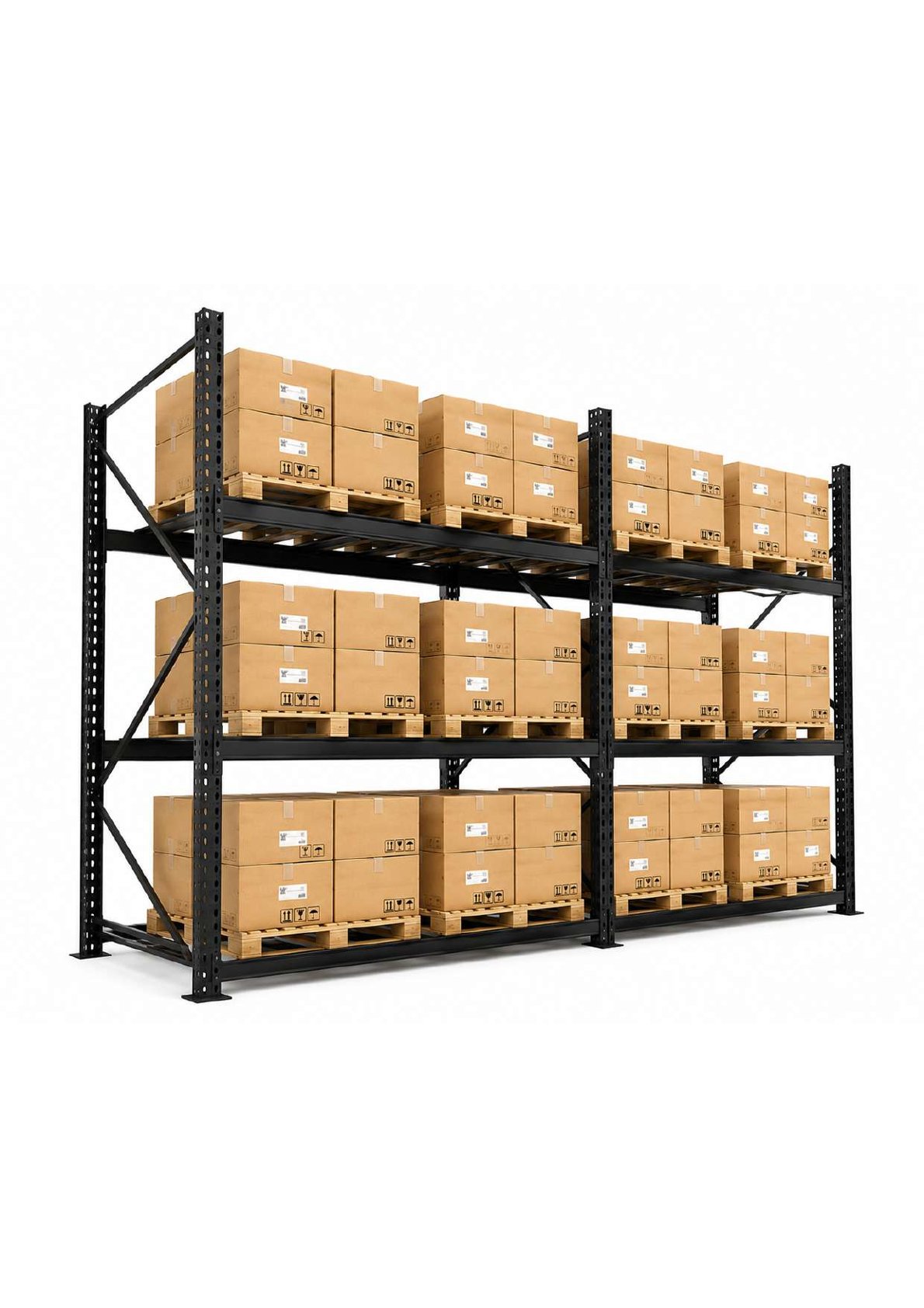
Selective pallet racking is the most widely used racking type in India and worldwide. Each bay is one pallet deep, and every pallet position faces an aisle, so a forklift can reach any pallet without moving another one first.
Best suited for
- Warehouses with a high number of SKUs and few pallets per SKU
- Operations with frequent picking and mixed order profiles
- Distribution centres, e-commerce fulfilment and 3PL facilities
- Businesses that need strict FIFO stock rotation (pharma, FMCG, food)
Advantages
- 100% selectivity — every pallet is directly accessible
- Works with standard counterbalance forklifts and reach trucks
- Lowest cost per pallet position among racking types
- Easy to reconfigure as beam heights and SKU mix change
Limitations
Selective racking uses the most aisle space of the three types, so storage density per square foot is the lowest. If you're storing many pallets of the same product, you're paying for aisle space you don't really need.
2. Double-Deep Pallet Racking
Double-deep pallet racking places two selective rows back-to-back on each side of an aisle, so each bay holds two pallets in depth. Removing every second aisle increases pallet positions by roughly 40% compared to standard selective racking in the same footprint.
Best suited for
- Moderate SKU counts with at least two or more pallets per SKU
- Beverage, packaging, building materials and consumer goods warehouses
- Facilities that need more density but can't justify drive-in lanes
Advantages
- Significantly higher storage density than selective racking
- Still uses standard racking components, so cost per position stays reasonable
- Fewer aisles means a smaller area to light, clean and manage
Limitations
Double-deep racking needs a deep-reach or double-deep reach truck, which is a real cost if your fleet is all counterbalance forklifts. Selectivity also drops to around 50% — the rear pallet can only be reached after the front pallet is moved — so it works best when both pallets in a bay are the same SKU.
Expert Insight
A common mistake is installing double-deep racking and then storing different SKUs front and back. That creates constant double-handling and erases the time saved by the extra density. Plan your slotting so each double-deep bay holds one SKU.
3. Drive-In Pallet Racking
Drive-in pallet racking removes the aisles between rows almost entirely. Instead of beams, pallets sit on continuous rails, and the forklift drives directly into the rack lane to place or retrieve pallets. A single lane can hold several pallets deep and several levels high.
Best suited for
- Large quantities of a few SKUs stored in bulk
- Cold storage and frozen food warehouses, where every cubic metre is expensive to refrigerate
- Seasonal stock, raw material buffers and non-perishable goods
- Operations comfortable with LIFO (last in, first out) rotation
Advantages
- The highest storage density of the three pallet racking types
- Makes the most of expensive floor space and building height
- Ideal where a lane can be dedicated to one SKU
Limitations
Only the front pallet in each lane is immediately accessible, so drive-in racking is a poor fit for high-SKU, fast-picking operations. Forklift drivers also need training and care, because they operate inside the rack structure — upright protection and guide rails are essential, not optional extras.
Selective vs. Double-Deep vs. Drive-In: Side-by-Side Comparison
Storage density
- Selective — lowest (baseline)
- Double-deep — roughly 40% more pallet positions than selective
- Drive-in — highest, often the best choice for bulk single-SKU storage
Pallet accessibility (selectivity)
- Selective — 100%, every pallet directly reachable
- Double-deep — around 50%, rear pallet blocked by the front pallet
- Drive-in — lowest, only the front pallet in each lane
Forklift requirement
- Selective — standard counterbalance forklift or reach truck
- Double-deep — deep-reach / double-deep reach truck
- Drive-in — counterbalance or reach truck, with trained operators working inside lanes
Stock rotation
- Selective — FIFO or LIFO, fully flexible
- Double-deep — effectively LIFO within each bay
- Drive-in — LIFO (single-entry lanes)
How to Choose the Right Pallet Racking Type: 6 Questions
During a site assessment, these are the questions that decide the recommendation. Answer them honestly for your own warehouse and the right configuration usually becomes obvious.
- How many SKUs do you store, and how many pallets per SKU on average?
- Do you need FIFO rotation for expiry-sensitive stock, or is LIFO acceptable?
- Which forklifts do you have today, and are you willing to add a reach truck?
- What is your clear building height up to the lowest obstruction (beams, lights, sprinklers)?
- What is the heaviest pallet you'll store, and what is the floor's load-bearing capacity?
- How fast is your stock moving — daily picks, weekly replenishment, or seasonal storage?
Rule of Thumb
Many SKUs and frequent picking → selective. Several pallets per SKU and a reach truck available → double-deep. Large volumes of a few SKUs, especially in cold storage → drive-in. Mixed profile → combine types zone by zone.
Aisle Width, Height and Load: Don't Skip the Engineering
Whichever type you choose, the racking must be engineered for your exact configuration. Aisle width depends on your forklift's turning radius — counterbalance forklifts typically need wider aisles than reach trucks. Rack height is limited by the forklift's lift height and the building's clear height. And every beam level must be rated for your heaviest pallet, not your average one.
If you're unsure how beam capacity, bay width and number of levels interact, our guide on how to calculate rack load capacity explains how to read a load chart and why capacity should never be assumed from a catalogue figure.
When Pallet Racking Isn't the Right Answer
Pallet racking is designed for palletised, boxed or crated loads. If you're storing long items such as pipes, steel bars or timber, a cantilever racking system is the better fit — see our comparison of pallet racking vs. cantilever racking. For small, hand-picked parts, slotted angle racks or a two tier rack usually make more sense than forklift-served racking.
Pallet Racking Manufacturer in Mumbai and Across India
Smart Storage Creation designs, manufactures and installs selective, double-deep and drive-in pallet racking from our ISO 9001, ISO 14001 and ISO 45001 certified facility in Vasai, Maharashtra. Since 2005 we've supplied racking to warehouses, manufacturing plants, cold stores and distribution centres across Mumbai, Maharashtra and Pan-India.
Every project starts with a free site assessment, where we review your SKU profile, forklift fleet, building height and floor condition before recommending a layout — so you get the configuration your operation needs, not a generic design. Contact us to book an assessment or request a quote.
Frequently Asked Questions (FAQ)
Conclusion
Choosing between the types of pallet racking systems is really a choice between density and accessibility. Selective racking gives you every pallet, double-deep gives you more pallets per aisle, and drive-in gives you the most pallets per square foot.
Match the configuration to your SKU count, stock rotation rule and forklift fleet — and don't be afraid to combine types across zones of the same warehouse.
Smart Storage Creation manufactures all three pallet racking configurations and recommends the right layout after a free site assessment, with engineered load ratings for every installation.